Walking Frame vs Rollator Guide | BMC Medical
A practical head-to-head comparison of Walking Frame and Rollator Guide, covering quick verdict, key differences, category winners, buyer fit, and FAQ.
Walking Frame vs Rollator Guide: Which Should You Choose?
Head-to-head comparison
Overall winner: Rollator for its superior blend of mobility, features, and user independence for a wider range of needs.
A rollator is the better choice for most individuals seeking enhanced mobility outdoors, with features like a seat, brakes, and storage. A walking frame provides maximum stability and is best for those with significant balance or weight-bearing challenges, primarily for indoor use or short-distance transfers.
Head-to-Head Scorecard
Walking Frame vs Rollator Guide: Key Differences
Choosing the right mobility aid is a critical decision that directly impacts safety, independence, and quality of life. While both walking frames and rollators serve to assist with mobility, they are designed for fundamentally different levels of support and activity. Understanding these core differences is the first step in making an informed choice, ideally in consultation with a GP or occupational therapist.
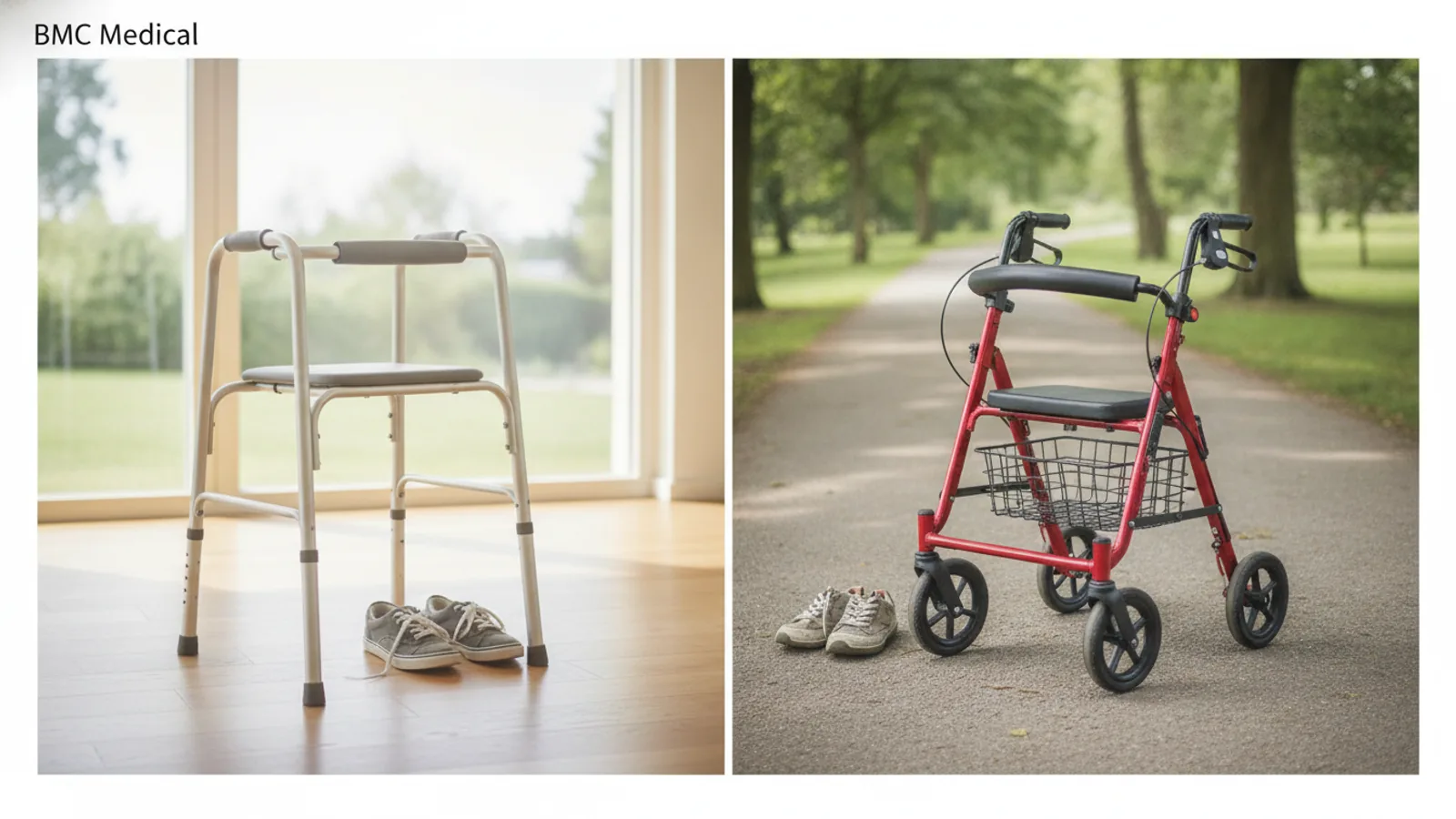
A walking frame, also known as a Zimmer frame, is the epitome of stability. It is a simple, lightweight frame, typically made of aluminium, with four legs capped with non-slip rubber ferrules. The user must lift the frame and place it a step ahead before walking into it. This "step-to" or "step-through" gait provides an exceptionally secure base of support, making it ideal for individuals with significant balance issues, weakness, or those recovering from surgery who have weight-bearing restrictions on a lower limb. Its primary function is to provide robust support, prioritising safety over speed.
A rollator, by contrast, is a walking frame with wheels, brakes, and often a built-in seat and basket. They typically have three or four wheels. This design eliminates the need to lift the device with every step. Instead, the user pushes the rollator forward, allowing for a more fluid, faster, and natural walking pattern. The inclusion of brakes provides crucial control over speed, especially on slopes, and can be locked for safety when standing up or using the seat. Rollators are designed for more active individuals who need support for balance and endurance over longer distances but do not require the constant, static support of a traditional frame.
In essence, the choice between a walking frame vs rollator guide hinges on a trade-off: a walking frame offers maximum stability at the cost of mobility, while a rollator offers maximum mobility with a slightly lower, yet still substantial, level of stability. This guide is based on extensive product research, analysis of NHS guidelines, and aggregated user feedback patterns to provide non-diagnostic educational context.
Measurement
Stability & Weight Bearing
Stability is arguably the most critical factor when selecting a mobility aid. It refers to the device's ability to prevent falls and provide a secure base of support. For users with significant balance impairment, muscle weakness, or post-operative weight-bearing limitations, the level of stability is non-negotiable.
The walking frame is the clear winner in this domain. Its design is entirely focused on creating a static, reliable base. With four legs firmly on the ground, the user is encased within a secure perimeter. The act of lifting and placing the frame forces a slow, deliberate pace, which inherently enhances safety and prevents the user from moving faster than their balance allows. When a user places their weight onto the handgrips, that force is distributed directly downwards through the four legs, providing an unmoving foundation. This makes it the standard recommendation from clinicians for patients during early stages of rehabilitation.
A rollator, while stable, introduces the dynamic element of wheels. This inherently reduces the level of static stability compared to a frame. While the brakes can and should be locked when stationary, the device can still move if the brakes are not engaged. For a user prone to sudden dizziness or loss of balance, a wheeled device can potentially roll away, increasing the risk of a fall. Four-wheeled rollators offer a wider and more stable base than three-wheeled models, but neither can match the locked-in security of a traditional walking frame. The stability of a rollator is sufficient for those who need guidance and support, but not for those who need to place their full body weight onto the device to prevent a fall.
Measurement
Mobility, Speed, & Outdoor Use
For many users, the goal of a mobility aid is not just to prevent falls but to enhance their ability to move around their community, engage in activities, and maintain independence. This is where mobility, speed, and suitability for outdoor terrain become paramount.
The rollator is engineered for mobility. The presence of wheels transforms the walking experience from a series of deliberate, halted steps to a smooth, continuous forward motion. This allows for a more natural and efficient gait, enabling users to walk faster and for longer distances with less fatigue. Rollators, particularly four-wheeled models with larger wheels (typically 6-8 inches in diameter), are designed to handle varied outdoor terrain. They can navigate pavements, slight inclines, grass, and gravel with relative ease, absorbing some of the vibrations from uneven surfaces. This makes them an excellent choice for trips to the shops, walks in the park, or simply navigating a larger home and garden.
Conversely, a walking frame significantly curtails mobility and speed. The "lift, place, step" sequence is slow and energy-intensive, especially over longer distances. Outdoors, a walking frame is cumbersome. The rubber ferrules can catch on cracks in the pavement, and lifting the frame over kerbs or uneven ground requires considerable upper body strength and coordination. It is not a practical tool for anything more than very short, flat, and smooth journeys, such as moving from a house to a waiting car.
Measurement
Features & Convenience
Beyond basic support, the practicality of a mobility aid is often determined by its additional features. These conveniences can significantly improve the user's experience, turning the device from a simple support into a multi-functional daily living aid.
The rollator is unmatched in this category. It is a feature-rich device designed for real-world use. The most significant feature is the integrated seat. This provides a safe and convenient place to rest at any time, which is invaluable for individuals with conditions that cause fatigue, such as COPD, heart conditions, or long COVID. This feature can be the difference between staying at home and feeling confident enough to go out. Secondly, virtually all rollators come equipped with hand-operated brakes. These are essential for controlling speed on slopes and for locking the device securely before sitting down. Finally, a storage basket or bag is a standard inclusion, allowing users to carry shopping, a handbag, or personal items, freeing up their hands and reducing the risk of imbalance.
A walking frame, in its standard form, has no such features. It is a purely functional device for support. While some accessories like small bags or trays can be purchased separately, they are not integrated into the design and can sometimes compromise stability. There is no seat for resting and no braking system, as the device is not designed for continuous motion. The simplicity of the walking frame is its strength in terms of stability, but it is a significant drawback when it comes to everyday convenience and utility.
Measurement
Ease of Use & Posture
The ease with which a user can operate their mobility aid and the effect it has on their posture are crucial for long-term comfort and safety. An aid that is difficult to manage or encourages poor posture can lead to secondary problems like back or shoulder pain.
For continuous walking, a rollator is easier to use. It glides forward with a gentle push, requiring minimal effort from the user. This encourages a more upright posture, as the user can walk within the frame of the rollator rather than hunching over it. The adjustable handle height allows for customisation to ensure the user's arms are comfortably bent, promoting good spinal alignment. However, a rollator does require a degree of coordination to operate the brakes and steer, which may be a challenge for some individuals with cognitive or upper limb impairments.
A walking frame requires more physical effort. The constant lifting and placing of the frame demand upper body strength and can be fatiguing over time. This action can also encourage a stooped posture, as users may lean forward excessively to move the frame. While simple in concept, the repetitive motion can be cumbersome. However, for the specific task of rising from a seated position, a walking frame can be easier and safer. The user can place the frame directly in front of their chair and use the sturdy handgrips to push themselves up, confident that the frame will not roll away.
Measurement
Portability & Storage
How easily a mobility aid can be folded, lifted, and stored is a key practical consideration, especially for users who travel by car or have limited space at home. A bulky or heavy device can become a barrier to getting out and about.
Walking frames generally have an advantage in this area due to their simplicity and lighter weight. Most basic aluminium frames weigh only 2-3 kg. They typically fold flat by pressing a simple button or catch, creating a slim profile that is very easy to slide into the back seat or boot of a car, or to store in a narrow space at home. Their inherent lightness makes them much easier for users or their carers to lift without strain.
Rollators are significantly heavier and bulkier. A typical four-wheeled rollator can weigh between 6 kg and 10 kg. While most are designed to fold, they often fold side-to-side or front-to-back, but remain quite large even when collapsed. Lifting a heavy rollator into a car boot can be challenging for an individual with strength limitations. While some lightweight carbon fibre models are available, they come at a much higher price point. The bulk of a rollator also means it takes up more storage space at home, which can be an issue in smaller houses or flats.
Measurement
Value & Cost
The financial aspect is a practical reality for many. While safety and suitability should always be the primary concerns, the initial purchase price and long-term value are important factors in the decision-making process.
In terms of upfront cost, the walking frame is the undisputed winner. It is a simple, mass-produced piece of equipment with few moving parts. A standard, high-quality walking frame can be purchased for a very modest price, often under £40. Its maintenance costs are also minimal, typically limited to the occasional replacement of the rubber ferrules on the bottom of the legs, which are inexpensive and easy to fit. For those on a tight budget needing basic, reliable support, the walking frame offers excellent value.
Rollators represent a more significant investment. The addition of wheels, a braking system, a seat, and a folding mechanism increases the complexity and cost of manufacturing. Prices for a reliable entry-level rollator typically start around £60-£80 and can extend to several hundred pounds for premium, lightweight, or specialised models. While the initial cost is higher, the rollator offers far greater functionality. When you consider the value of the integrated seat, storage, and enhanced mobility, a rollator provides excellent value for money for the active user. The decision on value, therefore, depends on the user's needs: a walking frame is cheaper, but a rollator provides more features and capability for its price.
Choose a Walking Frame If:
- You require maximum stability: Your primary need is to prevent falls, and you have significant balance problems or weakness.
- You have weight-bearing restrictions: You are recovering from hip, knee, or ankle surgery and have been advised by a clinician to limit the weight on one leg.
- Your mobility is mainly indoors: You primarily need support for moving around your home, especially in tighter spaces like hallways and bathrooms.
- You need help rising from a chair: You require a sturdy, unmoving support to push up from a seated position.
- Your budget is a primary concern: You need the most affordable and simple solution for basic support.
- You need a very lightweight device: You or your carer need an aid that is extremely easy to lift and place in a car.
Choose a Rollator If:
- You want to maintain an active lifestyle: You are steady on your feet but need support for balance and endurance to walk longer distances outdoors.
- You experience fatigue when walking: You would benefit from a built-in seat to take rest breaks while out shopping or on a walk.
- You need to carry items: You want the convenience of a basket or bag to transport shopping, a handbag, or an oxygen cylinder, keeping your hands free.
- You want a more natural walking pattern: You wish to avoid the start-stop motion of a frame and move more fluidly and at a faster pace.
- You will be navigating varied terrain: Your typical routes include pavements, gentle slopes, or park paths where wheels are a distinct advantage.
- Your posture is a concern: You want an aid that encourages a more upright posture during movement.
Final Verdict: Walking Frame vs Rollator Guide
The choice between a walking frame and a rollator is a personal one that must be guided by individual needs, physical capabilities, and lifestyle goals. It is not a matter of one being definitively "better" than the other, but of which is the correct clinical and practical tool for the specific user.
The walking frame is a specialist tool for stability. It excels in providing a secure, unmoving base of support, making it the safest option for individuals at high risk of falls, those with severe mobility impairments, or patients in the early stages of post-operative recovery. Its simplicity, low cost, and light weight are significant advantages for indoor use and easy transport. However, this focus on stability comes at the expense of fluid mobility, speed, and convenience.
The rollator is a versatile tool for independence. It empowers users who have fair balance but limited endurance to remain active, social, and engaged with their community. The combination of wheeled mobility, a seat for rest, brakes for control, and a basket for storage makes it a comprehensive lifestyle aid. While it does not offer the same absolute stability as a frame, it provides ample support for a wide range of users, promoting a healthier, more active life.
For these reasons, the Rollator is our overall winner. It addresses the needs of a broader spectrum of users aiming to enhance their mobility and maintain their independence. However, we strongly reiterate that this conclusion should be validated by a healthcare professional. An assessment by a GP or an occupational therapist is the safest and most effective way to ensure you choose the mobility aid that is perfectly matched to your specific health requirements.
Walking Frame vs Rollator Guide: Which Should You Choose? FAQ
Should I consult a doctor before buying a walking aid?
Absolutely. It is highly recommended to consult with a GP, physiotherapist, or occupational therapist before purchasing any mobility aid. They can perform a thorough assessment of your strength, balance, gait, and cognitive function to recommend the most appropriate and safest device for your specific needs. An incorrect choice can increase the risk of falls.
Can I use a rollator to help me stand up from a chair?
Yes, but with extreme caution. You must ensure the brakes are firmly locked before putting any weight on the rollator. A walking frame is generally safer for this purpose as it cannot roll. If using a rollator, push down on the handgrips, not forward, to avoid tipping it.
What is the difference between a 3-wheel and 4-wheel rollator?
A 4-wheel rollator has a wider, more stable base and almost always includes a seat, making it better for outdoor use and for those who need to rest. A 3-wheel rollator is more manoeuvrable in tight indoor spaces due to its smaller turning circle, but it is less stable and typically does not have a seat.
How do I set the correct handle height for my walking frame or rollator?
Stand up straight inside the frame or rollator with your arms hanging loosely at your sides. The top of the handgrips should be level with your wrist crease. When you place your hands on the grips, your elbows should have a slight, comfortable bend of about 15-20 degrees. An incorrect height can lead to poor posture and shoulder or back pain.
Are there different types of walking frames?
Yes. Besides the standard non-wheeled frame, there are also wheeled walking frames (sometimes called "two-wheel walkers"). These have two wheels on the front legs and two non-slip ferrules on the back. The user pushes the frame forward rather than lifting it, offering a middle ground between the stability of a standard frame and the mobility of a rollator. They are often used for individuals who lack the upper body strength to lift a standard frame with every step.