Nebuliser vs Inhaler: Which Should You Choose? | BMC Medical
A practical head-to-head comparison of Nebuliser and Inhaler, covering quick verdict, key differences, category winners, buyer fit, and FAQ.
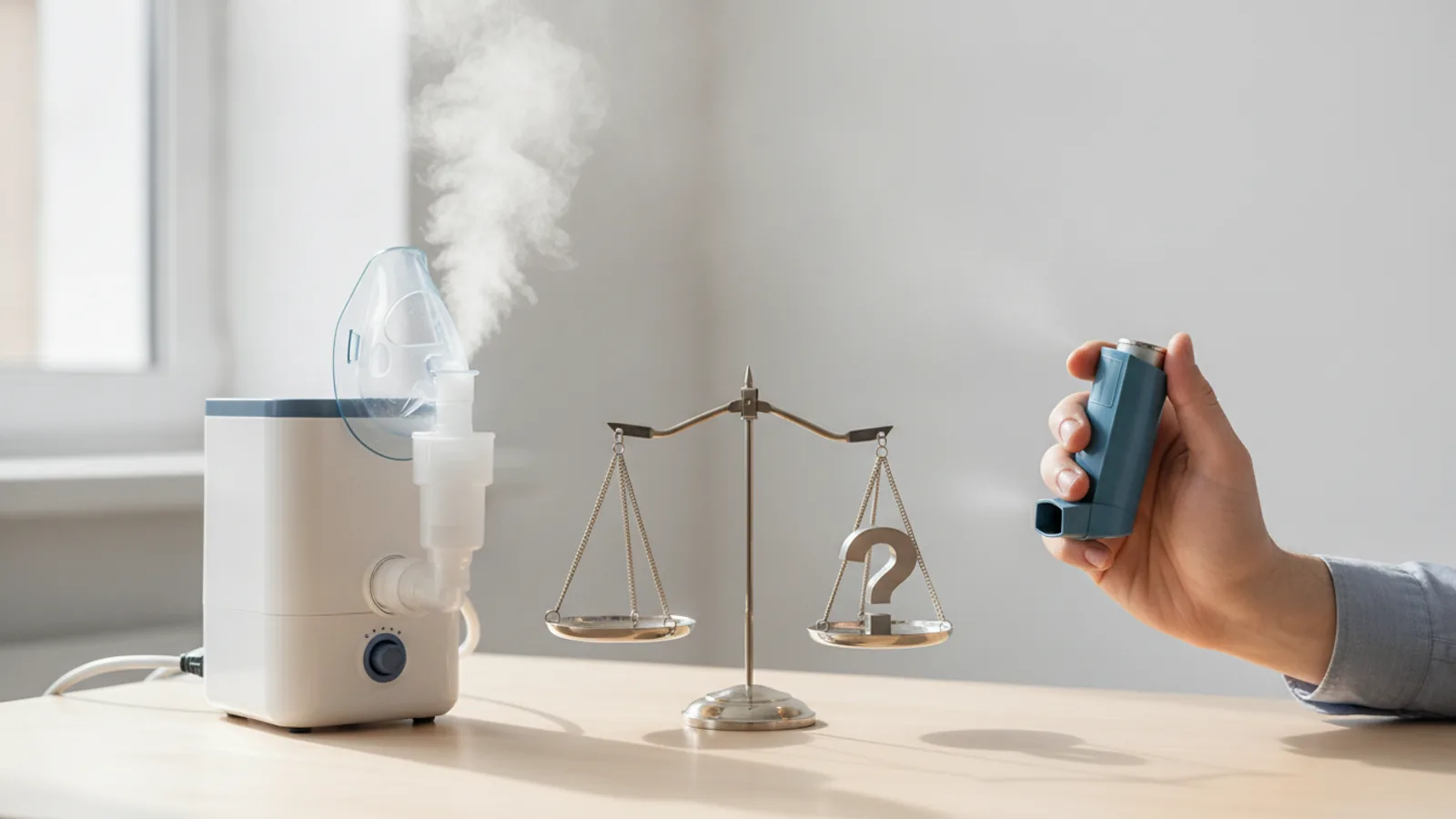
Nebuliser vs Inhaler: Which Should You Choose?
Head-to-head comparison
Overall winner: Inhaler for its convenience, portability, and suitability for routine management of chronic respiratory conditions.
For most individuals managing long-term conditions like asthma or COPD, the inhaler is the superior choice for daily use due to its speed and portability. However, a nebuliser is indispensable for delivering medication during severe respiratory episodes, or for patients who cannot coordinate their breathing effectively, such as young children and the elderly.
Disclosure: This comparison is based on extensive product research, analysis of NHS guidelines, and aggregation of public user feedback. We have not conducted direct clinical trials. All medical device choices should be made in consultation with a qualified healthcare professional. This content may contain affiliate links, which helps support our work at no cost to you.
Option A
Nebuliser
- Best fit: Severe attacks, young children, and adults with coordination difficulties.
- Strength: Passive, deep delivery of medicated mist without requiring coordinated breathing.
- Tradeoff: Slower treatment time, requires a power source, and is not easily portable.
Option B
Inhaler
- Best fit: Routine daily management of asthma, COPD, and other chronic respiratory conditions.
- Strength: Fast, portable, and delivers a precise, metered dose of medication quickly.
- Tradeoff: Requires correct inhalation technique and coordination to be fully effective.
Head-to-Head Scorecard
Nebuliser vs Inhaler: Key Differences
While both nebulisers and inhalers deliver medication directly to the lungs, their mechanisms and ideal use cases are fundamentally different. Understanding these distinctions is crucial for effective respiratory care, as prescribed by your clinician.
An inhaler is a compact, portable device that delivers a measured burst of medication in an aerosol or powder form. Its effectiveness hinges on the user's ability to inhale deeply at the precise moment the medication is released. This requires coordination and practice. The primary types are Metered Dose Inhalers (MDIs), which use a chemical propellant to push the medication out, and Dry Powder Inhalers (DPIs), which are breath-activated.
A nebuliser, by contrast, is a machine that converts liquid medication into a fine mist. The user inhales this mist through a mouthpiece or mask over a period of 5 to 15 minutes. It does not require special breathing coordination; the patient simply breathes normally. This makes it an essential tool in hospitals, for home use during severe exacerbations, and for specific patient groups like infants, toddlers, and individuals with severe disabilities or acute respiratory distress.
The core trade-off is portability versus passive delivery. Inhalers offer freedom and speed for managing chronic conditions on a day-to-day basis. Nebulisers provide a more robust, less technique-dependent treatment method for situations where an inhaler may be difficult or less effective to use.
Measurement
Routine fit
How a respiratory device integrates into your daily life is a critical factor for adherence to treatment plans. For individuals with active lifestyles who need to manage their condition at work, school, or while travelling, the inhaler is unparalleled.
An inhaler is small enough to fit in a pocket, purse, or desk drawer. Its use is quick, often taking less than a minute, and can be done discreetly. This "on-the-go" capability ensures that medication is always at hand for both scheduled maintenance doses and immediate relief from symptoms like wheezing or shortness of breath.
A nebuliser is a far more deliberate treatment. Most models require a stable surface and a power source (either mains electricity or a rechargeable battery). The treatment session itself lasts several minutes, requiring the user to be stationary. While modern portable nebulisers exist, they are still significantly larger and more conspicuous than inhalers. Consequently, nebulisers are best suited for scheduled treatments at home, rather than for managing symptoms throughout a busy day.
Measurement
Formula or feature (Medication Delivery Efficacy)
The effectiveness of medication delivery is paramount. Here, the "winner" depends entirely on the clinical context. For a stable, cooperative patient, both devices are highly effective when used correctly.
Inhalers deliver a precise, metered dose. When the user's technique is correct—a coordinated, deep, and sustained inhalation—the medication is efficiently deposited in the airways. However, studies have shown that improper technique is common and can significantly reduce the amount of medication reaching the lungs. Spacers can be used with MDIs to mitigate this issue, acting as a holding chamber to make timing the breath less critical.
Nebulisers excel when a patient is unable to use an inhaler correctly. During a severe asthma attack, a person may be too breathless to take the deep inspiration required for an inhaler. A nebuliser allows them to receive a continuous flow of medicated mist through normal, shallow breathing. This passive delivery ensures the medication reaches deep into the lungs even under respiratory distress. It is also the preferred method for infants and young children who cannot be taught to coordinate their breathing for an MDI.
Measurement
Ease of use
At first glance, an inhaler appears simpler. However, "ease of use" must account for the cognitive and physical requirements of operation. Using an MDI correctly involves shaking the device, un-capping it, breathing out fully, positioning it correctly, pressing the canister while breathing in slowly and deeply, holding the breath, and then exhaling. This multi-step process can be challenging for many.
A nebuliser, while involving more equipment (the compressor, tubing, and medication cup), is operationally simpler from the patient's perspective. Once the medication is in the cup and the machine is turned on, the only requirement is to sit and breathe normally with the mask or mouthpiece in place. There is no special technique to learn or physical coordination required.
This makes the nebuliser far easier to use for key patient populations: young children who won't follow complex instructions, elderly patients with cognitive or motor skill impairments, and anyone experiencing severe breathlessness. For the caregiver, setup and cleaning are more involved, but for the patient, the process is effortless.
Measurement
Value (Cost & Accessibility)
In the UK, the cost of medication is largely determined by NHS prescription charges. However, the cost of the delivery device itself can vary. Inhalers are typically dispensed by a pharmacist along with the prescribed medication, with the cost included within the standard prescription fee. This makes them highly accessible with no significant upfront hardware cost for the patient.
Nebulisers are a different matter. While they may be provided by the NHS for specific, severe conditions under specialist care, many patients purchase them privately for home use. A reliable home nebuliser can cost anywhere from £40 to over £150, depending on the model (e.g., stationary jet vs. portable mesh). This represents a notable upfront investment.
Furthermore, the liquid medication vials (nebulas) used in a nebuliser may sometimes be more expensive per dose than the equivalent medication in an inhaler canister. From a pure accessibility and low-entry-cost perspective, the inhaler model is more favourable for the majority of users.
Measurement
Buyer confidence (Portability & Reliability)
Confidence in a medical device comes from knowing it will be available and functional when you need it most. In this regard, the portability of inhalers is their greatest asset. A rescue inhaler (like a blue salbutamol MDI) provides immense peace of mind because it can be carried at all times. This constant availability means help is seconds away should symptoms suddenly arise, whether you are on a walk, at the shops, or on public transport.
While nebulisers are reliable machines, their lack of true portability is a major limitation for confidence outside the home. A mains-powered unit is useless during a power cut or when away from an outlet. Even battery-powered portable models are bulky compared to an inhaler and have a finite battery life. You cannot easily slip a nebuliser into your pocket for a day out.
Reliability of the mechanism itself is high for both devices, provided they are maintained and cleaned according to manufacturer instructions. However, the confidence that comes from immediate, anytime, anywhere access to medication firmly rests with the inhaler.
Choose Nebuliser If
- You are treating an infant or young child: Their inability to coordinate breathing makes a nebuliser with a mask the most effective option.
- You experience severe or frequent respiratory attacks: During an acute episode, you may be too breathless to use an inhaler correctly. A nebuliser ensures medication delivery.
- You have a physical or cognitive impairment: Conditions that affect motor skills or the ability to follow instructions (e.g., arthritis, dementia) make the passive use of a nebuliser safer and more effective.
- Your doctor has prescribed a medication only available in liquid form for nebulisation: Some specific medications, such as certain antibiotics or mucolytics, are administered this way.
- You find inhaler technique difficult to master: Despite coaching and the use of a spacer, if you cannot use an inhaler effectively, a nebuliser is a reliable alternative for home treatment.
Choose Inhaler If
- You need to manage a chronic condition daily: For routine maintenance and prevention of symptoms from asthma or COPD, an inhaler is the standard of care.
- You live an active lifestyle: An inhaler's portability allows you to carry your medication with you to work, school, the gym, or on holiday.
- You require quick relief from sudden symptoms: A rescue inhaler can deliver a dose of bronchodilator in seconds to quickly open your airways.
- You have been trained in the correct technique: When used properly, an inhaler is a highly efficient and effective medication delivery system.
- Your clinician has prescribed it for your specific condition: The vast majority of patients with asthma and COPD are prescribed inhalers as their primary treatment device.
Final Verdict: Nebuliser vs Inhaler
The choice between a nebuliser and an inhaler is not about which is "better" overall, but which is clinically appropriate for the patient and the situation. However, for the purpose of a direct comparison for the majority of users, the inhaler is the clear winner for routine, daily management of respiratory conditions. Its blend of speed, portability, convenience, and proven efficacy makes it the cornerstone of modern asthma and COPD care.
This does not diminish the critical role of the nebuliser. The nebuliser remains an essential tool for emergency situations and for specific patient groups who cannot use an inhaler. It is a vital piece of medical equipment for hospitals and for home care in severe cases. For those who need it, the nebuliser is not just a preference but a necessity.
Ultimately, your GP, respiratory nurse, or specialist will determine the most suitable device for your needs. They will consider your diagnosis, the severity of your condition, your physical abilities, and your lifestyle to prescribe the safest and most effective treatment plan.
Nebuliser vs Inhaler: Which Should You Choose? FAQ
Do I need a prescription for a nebuliser in the UK?
You can purchase a nebuliser machine online or from a pharmacy without a prescription. However, the liquid medication (nebulas) required to use in the machine is prescription-only. You should only use a nebuliser under the guidance of a healthcare professional who has prescribed the appropriate medication for you.
Can I use a nebuliser for a common cold or cough?
A nebuliser can be used with a sterile saline solution (salt water) to help loosen mucus and soothe airways during a cold or cough. However, you should never use prescription medication like salbutamol or corticosteroids for a common cold unless specifically instructed by your doctor. Using these medications unnecessarily can have side effects and may not be effective for viral infections.
Is a nebuliser more powerful than an inhaler?
Not necessarily. The term "powerful" can be misleading. A nebuliser treatment often delivers a larger total volume of medication over a longer period (5-15 minutes), which is beneficial during a severe attack. An inhaler delivers a very concentrated, precise dose in seconds. When used correctly, an inhaler is just as effective as a nebuliser for routine management and mild to moderate symptoms. The key difference is the delivery method, not the inherent strength of the medication.
What is a spacer and how does it relate to inhalers?
A spacer (or holding chamber) is a plastic tube that attaches to a Metered Dose Inhaler (MDI). It helps to solve the coordination problem of pressing the canister and inhaling at the same time. You spray the medication into the spacer, and then you can breathe in from the other end in your own time. Spacers make inhalers easier to use and help more medication get into the lungs instead of the mouth and throat. They are highly recommended for children and for any adult who struggles with MDI technique.
How often do I need to clean my nebuliser or inhaler?
Regular cleaning is essential to prevent infection and ensure the device works correctly. For a nebuliser, the mouthpiece/mask and medicine cup should be rinsed after every use and washed thoroughly with warm, soapy water daily. The tubing and compressor should be wiped down regularly. For an inhaler, the plastic casing should be cleaned weekly according to the manufacturer's instructions. Always refer to the patient information leaflet that comes with your specific device for detailed cleaning and maintenance guidelines.