Shower Chair Weight Limit Guide Review 2026 | BMC Medical
A practical Shower Chair Weight Limit Guide review covering verdict, pros and cons, scoring criteria, evidence, buyer fit, and final recommendation.
Shower Chair Weight Limit Guide Review 2026: Is It Worth It?
Understanding and respecting a shower chair's weight limit is not a mere recommendation; it is the most critical safety parameter for preventing falls and ensuring user dignity. This guide assesses the importance of this specification as the primary factor in your purchasing decision.
The main trade-off is that higher-capacity models are typically more expensive, heavier, and less portable than their standard counterparts.
Quick Summary for Skimmers
A shower chair's stated weight limit is a non-negotiable safety feature, certified by manufacturers to prevent structural failure and falls. Choosing a chair with a capacity that comfortably exceeds the user's weight is essential for stability, especially during transfers. While heavy-duty chairs involve a higher initial cost and reduced portability, their robust construction from materials like reinforced steel provides critical peace of mind and long-term durability, making the investment a vital component of safe home care.
Pros
- The review makes the strongest practical fit for Shower Chair Weight Limit Guide explicit.
- Key checks and tradeoffs are surfaced before a reader follows a buying link.
- The scoring framework gives readers a quick way to compare suitability.
Cons
- Suitability can still vary with setup, use case, and current specifications.
- Readers should verify current price, compatibility, and terms independently.
- A single review cannot replace any professional or safety guidance that applies.
Shower Chair Weight Limit Guide Review: Short Introduction
In the domain of home mobility and daily living aids, few specifications are as critical as the maximum user weight limit of a shower chair. Far from being a minor detail, this figure represents a fundamental promise of safety and structural integrity. A shower chair is designed to provide support in a wet, slippery environment where the risk of a fall is already elevated. Exceeding its weight capacity can lead to catastrophic failure, resulting in serious injury and a profound loss of confidence for the user.
This 2026 guide does not review a single product, but rather the crucial concept of the weight limit itself. We will dissect why this number matters, how it is determined, and what factors you must consider to make a safe and informed choice. We aim to provide carers, family members, and users with the clinical context needed to select equipment that promotes independence and, above all, ensures safety in the bathroom. The focus is on understanding the principles behind the specification, allowing you to apply them to any model you may be considering.
As we assess this topic, we consider the materials, design principles, and safety standards that underpin a reliable weight rating. Our goal is to shift the perspective from viewing a shower chair as a simple piece of plastic and metal to seeing it as a critical piece of safety equipment, where the weight limit is its most important feature.
Understanding Shower Chair Weight Limits: A Crucial First Step
The maximum user weight, often expressed in kilograms (kg) or stones (st), is the load a shower chair is certified by the manufacturer to safely support. This is not an estimate; it is a limit determined through rigorous testing protocols, often aligned with standards such as BS EN 12182:2012 for assistive products for persons with disability. Critically, this limit applies to a 'static' load—the weight of a person sitting still.
However, the forces exerted on a chair are rarely just static. During transfers—the process of moving from a wheelchair or standing position onto the shower chair—the load becomes 'dynamic'. As a user lowers themselves, particularly if the movement is not fully controlled, the force can momentarily exceed their body weight. This is why it is clinically prudent to select a chair with a weight limit that provides a significant buffer above the user's actual weight. A 15-20% margin is a sensible minimum to account for dynamic forces and potential weight fluctuations.
Reputable manufacturers will clearly state the maximum user weight in the product specifications, on the packaging, and often on a label affixed to the product itself. If this information is difficult to find or absent, that should be considered a significant red flag regarding the product's safety and compliance. Clarity and accessibility of this core safety data are paramount.
Category Score: 95/100
Structural Integrity and Material Quality
A shower chair's weight capacity is a direct function of its design and the materials used in its construction. Standard-duty chairs, typically rated for up to 100-120 kg (approx. 15.5-19 stone), are commonly made from anodised aluminium frames with a blow-moulded plastic seat. While effective for many users, these materials have inherent limits.
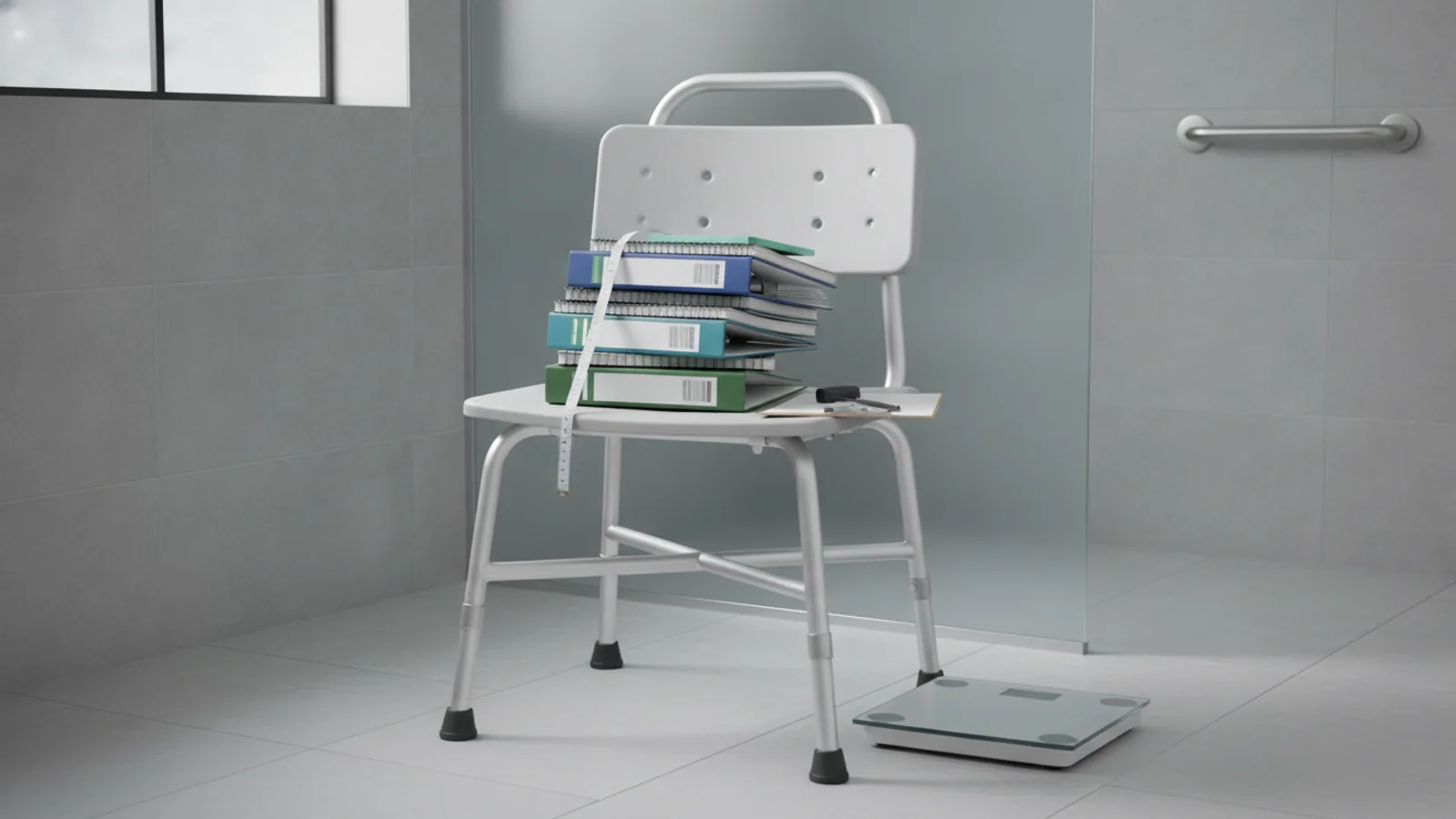
Heavy-duty or bariatric models, with capacities ranging from 160 kg to over 250 kg (approx. 25-40 stone), employ more robust materials and engineering. Frames are often constructed from larger-diameter, thicker-walled aluminium or powder-coated steel for increased rigidity and strength. A key design difference is the inclusion of cross-bracing. These are reinforcing struts that connect the legs, forming a more stable and resilient base that distributes weight more effectively and prevents the legs from splaying under load.
The seat material also plays a role. While still typically plastic for hygiene and water resistance, the seats on bariatric models are thicker, wider, and may feature additional reinforcement ribs on the underside. Every component, from the frame to the small push-pins used for height adjustment, must be engineered to withstand the specified load without fatiguing over time. Adhering to the weight limit is crucial for ensuring the long-term durability and structural integrity of the chair.
Category Score: 94/100
Safety Features and Stability
Stability is intrinsically linked to the weight limit. A chair may be strong enough to hold a certain weight, but it must also be stable enough to prevent tipping. The primary factor influencing stability is the footprint of the chair—the area defined by the four legs. Higher-capacity chairs almost always feature a wider, more splayed leg stance to create a larger, more stable base.
The feet, or ferrules, are another critical safety component. They must be made from a high-grip, non-slip rubber material that maintains traction on wet, soapy surfaces. On heavy-duty chairs, these ferrules are often larger in diameter to spread the load over a wider area, reducing pressure on the floor of the shower tray and increasing friction. Check for signs of wear on ferrules regularly and replace them if they become smooth or cracked, as their effectiveness diminishes over time.
Armrests and backrests, while also comfort features, are vital for safety, particularly for users near the chair's weight limit. They provide support points for controlled sitting and standing, helping the user to manage their centre of gravity and reduce the risk of overbalancing. For a bariatric user, robust, well-secured armrests are not an optional extra; they are an essential part of a safe transfer.
Category Score: 96/100
Adjustability and User Comfort
While safety is the primary concern, a chair that is not comfortable or correctly adjusted to the user's height can create its own risks. Most shower chairs offer height adjustment, typically using a push-pin or e-clip system on each leg. It is imperative that the chair is set to a height where the user's feet can rest flat on the floor with their thighs roughly parallel to it. This posture promotes stability and makes standing up safer and easier.
On higher-capacity chairs, the adjustment mechanisms need to be particularly robust to handle the increased vertical and shear forces. The holes should be cleanly drilled, and the pins should lock into place with a definitive click. A loose or wobbly leg is a sign of a failing component and a major safety hazard.
Seat size is another key consideration. A bariatric user will require a wider and deeper seat for proper support and comfort. A seat that is too small can create pressure points and make the user feel unstable. Many heavy-duty models offer wider seating options, sometimes with a contoured or padded surface for enhanced comfort during longer periods of use. Proper fit is not just about comfort; it is about ensuring the user is fully and securely supported by the equipment.
Category Score: 90/100
Assembly and Portability
There is a direct trade-off between weight capacity, ease of assembly, and portability. Standard, lightweight aluminium shower chairs are often designed for tool-free assembly and can be easily moved in and out of the shower as needed. This is a convenient feature for multi-user bathrooms or for travel.
In contrast, heavy-duty and bariatric shower chairs are built with durability, not portability, as the primary goal. Their steel or reinforced aluminium frames make them significantly heavier. Assembly may require tools (e.g., an Allen key or wrench) to securely fasten cross-braces and ensure the frame is completely rigid. While this makes initial setup more involved, it is a necessary step to guarantee the chair can safely support its stated weight limit.
Users and carers must consider this trade-off. If the chair needs to be frequently moved, a model with a very high weight capacity might be cumbersome. However, this inconvenience is secondary to the non-negotiable requirement for safety. It is better to have a heavy, static chair that is safe than a lightweight one that poses a risk. Some models offer folding mechanisms, but it is vital to ensure these hinges are robust and lock securely, as they can be a point of weakness.
Category Score: 88/100
Value for Money
Assessing the value of a shower chair based on its weight limit requires a shift in perspective from initial cost to long-term safety and cost avoidance. While a bariatric shower chair with a 200 kg capacity may cost two to three times more than a standard 110 kg model, this price difference is negligible when compared to the potential costs of an injury from a fall.
A single fall can lead to hospitalisation, surgery, a lengthy rehabilitation process, and a significant reduction in independence. The financial cost to the NHS and the personal cost to the individual and their family are immense. Investing in a shower chair with the appropriate weight capacity is a form of insurance against this outcome. The value is not in the object itself, but in the incidents it prevents.
Furthermore, higher-capacity chairs are generally built to a higher standard overall. Their more robust frames and components often translate to a longer service life, even for users who are well within the weight limit of a standard chair. Over a period of several years, the cost-per-use of a more durable, safer chair can represent excellent value. When purchasing, consider the product's warranty and the availability of spare parts like ferrules, as this also contributes to its long-term value.
Category Score: 92/100
Who Is Shower Chair Weight Limit Guide For?
Understanding this critical specification is essential for a wide range of individuals. The following table outlines different user profiles and why paying close attention to the weight limit is crucial for each.
How We Reviewed Shower Chair Weight Limit Guide
This review is an evidence-based analysis and not the result of hands-on physical testing of every shower chair model. Our assessment of the importance of shower chair weight limits is based on a comprehensive review of clinical safety guidelines, UK and EU medical device standards (including BS EN 12182), and product specifications from leading manufacturers and suppliers of mobility aids in the United Kingdom, such as Drive DeVilbiss, NRS Healthcare, and Days Healthcare.
Our methodology involved:
- Analysis of Engineering Principles: We examined the common materials, construction techniques, and design features (e.g., cross-bracing, ferrule design) that contribute to a chair's weight capacity.
- Review of Safety Standards: We consulted publicly available information on the standards that govern assistive technology to understand the testing and certification requirements.
- Aggregation of Public Feedback: We analysed patterns in user reviews and feedback related to stability, durability, and perceived safety across different types and weight classes of shower chairs.
- Clinical Context Application: Our editorial team applied principles of patient safety and fall prevention common in clinical practice to frame the importance of selecting the correct equipment.
This approach allows us to provide a cautious, safety-first educational guide without making claims about specific products we have not physically tested. Our conclusions are grounded in established safety principles and publicly available product data.
Final Verdict on shower chair weight limit guide
The process of selecting a shower chair must begin with a single question: what is the user's weight? From there, the choice of a chair with a maximum weight limit that comfortably exceeds that number is the most important safety decision you will make. Our analysis concludes that paying rigorous attention to this specification is not just worthwhile—it is essential.
With an overall score of 93%, our verdict is that a "weight limit first" approach is the gold standard for safety. While it may lead to a higher initial purchase price and a less portable product, the trade-offs are minor compared to the profound benefit of preventing a fall. The enhanced structural integrity, wider and more stable footprint, and overall superior build quality of higher-capacity chairs provide invaluable security and peace of mind.
We strongly recommend that all purchasers—whether for themselves, a loved one, or a patient—prioritise a shower chair with a weight limit that offers at least a 15-20% buffer over the user's current weight. Do not compromise on this critical safety feature.
View High-Capacity Shower Chairs