Mobility Aids For Elderly At Home | BMC Medical
A practical step-by-step guide to mobility aids for elderly at home, including preparation, instructions, common issues, tips, and next steps.
Mobility Aids For Elderly At Home
This guide provides a structured approach to selecting, fitting, and safely using mobility aids for elderly individuals within the home. It is designed for family members, caregivers, and users to understand the process of assessing needs and creating a safer living environment. Following these steps helps reduce the risk of falls, improve independence, and ensure the chosen aid is appropriate and correctly configured. This information is for educational purposes and is not a substitute for professional medical advice.
Fast Answer
- First Step: Consult a healthcare professional, such as a GP, Physiotherapist, or Occupational Therapist (OT), for a thorough assessment of mobility needs.
- Key Goal: Match the right type of aid to the individual's specific physical requirements and their home layout to maximise safety and independence.
- Common Aids: Walking sticks, crutches, walkers (Zimmer frames), rollators, and grab bars are the most frequent in-home solutions.
Before You Start
- A consultation with a GP, Occupational Therapist (OT), or Physiotherapist. This is the most critical prerequisite.
- A notepad and pen to document daily challenges and home measurements.
- A measuring tape for doorways, hallways, and user height.
- A clear understanding of the individual's daily routines, including trips to the bathroom, kitchen, and bedroom.
- An open conversation with the intended user about their comfort, concerns, and preferences.
Step-by-Step Instructions
Assess the Individual's Specific Mobility Needs
Before considering any device, conduct a careful, non-diagnostic observation of the individual's mobility. The goal is to identify specific challenges. Note where they struggle most. Is it rising from a chair? Is it walking short distances, like from the living room to the kitchen? Do they feel unsteady when turning or standing for periods?
Document answers to these questions:
- Balance: Does the person experience dizziness or unsteadiness?
- Strength: Is there weakness in the legs, arms, or core that affects their ability to stand or walk?
- Endurance: How far can they walk before feeling tired or needing to rest?
- Pain: Does walking or standing cause pain in joints like hips, knees, or the back?
This information is vital for the conversation with a healthcare professional. It provides a clear picture of daily life and helps them recommend the most appropriate support.
Evaluate the Home Environment for Hazards and Obstacles
A mobility aid is only as safe as the environment it's used in. Walk through the home and identify potential risks. Use your measuring tape to check the width of doorways, hallways, and tight corners, especially if considering a walker or wheelchair.
Look for common hazards:
- Trip Hazards: Remove loose rugs, electrical cords, and general clutter from all pathways.
- Floor Surfaces: Note any transitions between different flooring types (e.g., carpet to tile) that are not level.
- Lighting: Ensure all areas, especially hallways, stairs, and bathrooms, are well-lit, particularly at night.
- Stairs: Assess the steepness and condition of stairs and handrails.
- Furniture: Arrange furniture to create wide, clear paths for movement.
Understand the Different Types of Mobility Aids
Familiarise yourself with the primary categories of aids to better understand a professional's recommendation. Each type offers a different level of support.
- Walking Sticks / Canes: Provide minimal support. Useful for individuals with minor balance issues or weakness on one side. They take about 25% of the user's weight.
- Crutches: Offer more support than a stick, often used in pairs. They are typically for short-term use after an injury but can be used long-term. They require good upper body strength.
- Walkers / Zimmer Frames: These are four-legged frames that the user lifts and places in front of them as they step. They provide a high degree of stability and are best for indoor use. They support up to 50% of a user's weight.
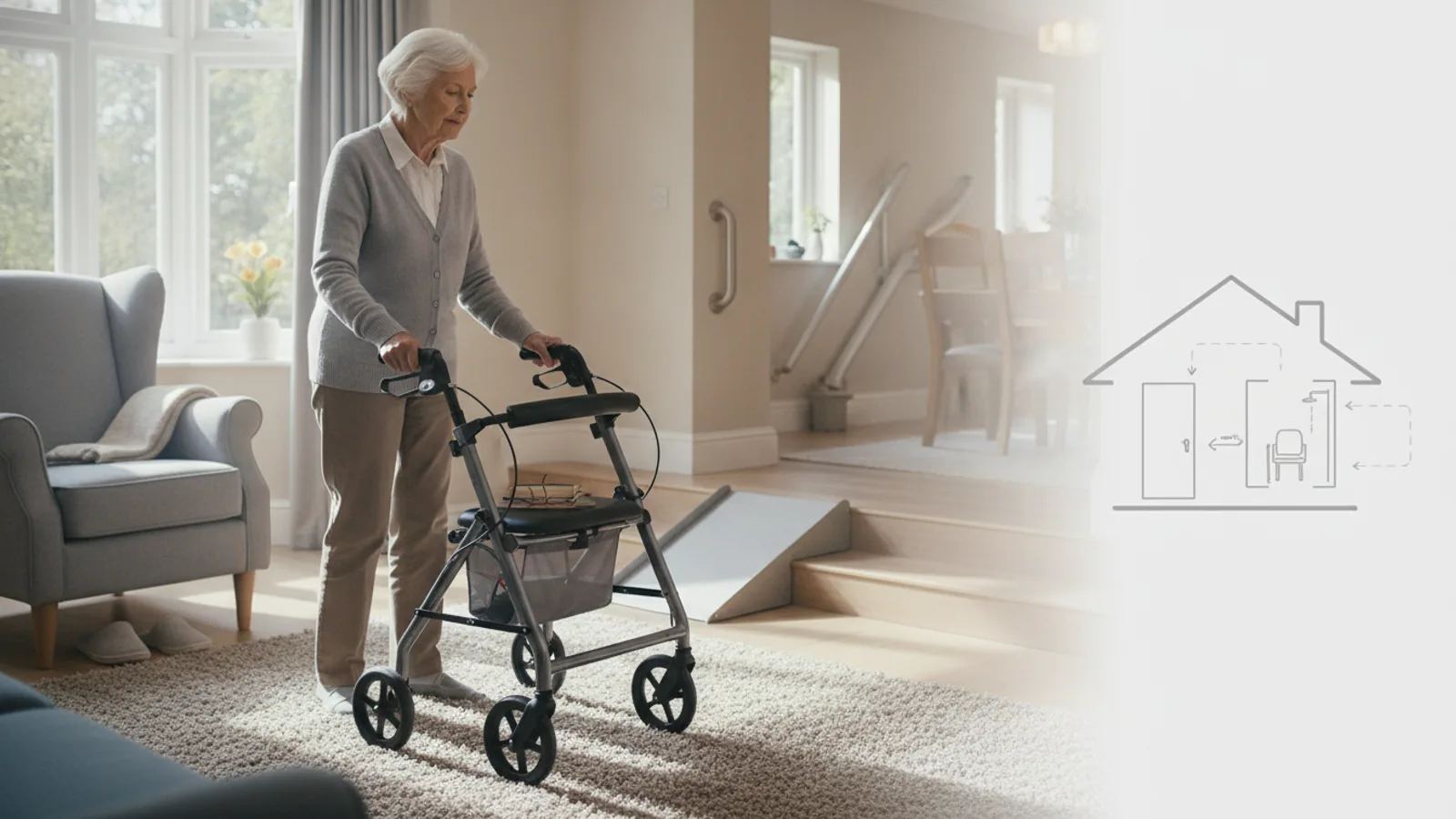
- Rollators: These are walkers with wheels, brakes, and often a seat. They allow for a more fluid walking pattern than a standard walker and are suitable for those who do not need to lean heavily on the frame for support. They are good for both indoor and outdoor use.
- Wheelchairs: For individuals who cannot walk or can only walk very short distances. They come in self-propelled or attendant-propelled models.
- Home Adaptations: These are fixed aids, such as grab bars in the bathroom, stairlifts, and ramps.
Ensure Correct Sizing and Professional Fitting
An incorrectly sized mobility aid is a serious safety risk. It can lead to poor posture, pain, and instability. While a physiotherapist or OT should perform the final fitting, you can take preliminary measurements.
For a walking stick or walker, the general rule is as follows:
- Have the user stand up straight in their normal day-to-day shoes, with arms hanging relaxed at their sides.
- The top of the handle of the walking stick or walker should be level with the crease of their wrist.
- When they hold the handgrip, their elbow should be bent at a comfortable angle, typically between 15 and 30 degrees.
Never accept a second-hand aid without having it checked and adjusted by a professional. Brakes on rollators must be tested, and rubber tips (ferrules) on sticks and frames must be in good condition, not worn smooth.
Practise Using the Aid Safely Under Supervision
Once you have the correctly sized aid, it's crucial to learn how to use it properly. This should ideally be guided by a physiotherapist. They can teach correct walking patterns and how to navigate common household situations.
- With a Walking Stick: The stick should be held on the stronger side of the body. It moves forward at the same time as the weaker leg.
- With a Walker/Zimmer Frame: Push or lift the frame a short distance ahead. Step into it, leading with the weaker leg first. Then bring the stronger leg forward. Keep the body upright.
- Sitting and Standing: Teach the user to back up to a chair until they feel it with their legs. They should reach back for the armrests with both hands before sitting. To stand, they should push up from the armrests, not pull up on the walker. The walker is for balance once standing, not for pulling oneself up.
Practise in a clear, open space first before attempting to navigate tighter corners or doorways. Patience is key during this learning phase.
Install Fixed Home Adaptations Securely
For aids like grab bars, secure installation is non-negotiable. These must be fixed into wall studs or solid masonry, not just plasterboard. If you are not an experienced DIYer, hire a professional handyman or contractor for this task.
An OT can advise on the best placement and orientation (vertical, horizontal, or diagonal) for grab bars to provide maximum benefit. Common locations include next to the toilet, inside the shower or bath, and along hallways or by steps. Incorrectly installed bars can pull out of the wall under load, causing a serious accident.
Conduct Regular Maintenance and Re-assessment
Mobility aids are subject to wear and tear. Establish a routine for checking the equipment. For walkers and rollators, check that brakes are working effectively and that wheels are not clogged with hair or debris. For walking sticks and frames, inspect the rubber ferrules at the bottom. If they are worn, cracked, or smooth, replace them immediately. Replacement ferrules are widely available from pharmacies and mobility shops.
Furthermore, a person's mobility needs can change over time. Schedule a review with their GP or therapist every six to twelve months, or sooner if you notice a significant change in their mobility, to ensure the current aid is still the most appropriate solution.
Quick Reference
| Situation | Potential Aid | Clinical Rationale |
|---|---|---|
| Minor unsteadiness, needs a confidence boost | Walking Stick / Cane | Provides a single point of contact to aid balance and sensory feedback. |
| Significant weakness or poor balance, mainly indoors | Walker / Zimmer Frame | Offers a wide, stable base of support; the user is enclosed within it. |
| Needs support but is more active, walks outdoors | Rollator (4-wheeled walker) | Allows for a more continuous gait. Brakes provide safety, and the seat allows for rest. |
| Difficulty getting up from the toilet or out of the bath | Grab Bars / Toilet Frame | Provides a fixed, stable point to push or pull up from, reducing strain and risk of falls. |
| Unable to safely manage stairs | Stairlift / Second Set of Aids | A stairlift is a mechanical solution. Alternatively, having a walker upstairs and downstairs can prevent the need to carry it. |
Common Problems When Using Mobility Aids
-
Problem: The user refuses to use the aid.
Solution: This can be due to concerns about appearance or denial about their needs. Have an empathetic conversation focusing on the goal of maintaining independence and preventing falls. Involving a healthcare professional can help, as their recommendation often carries more weight. Sometimes, a more modern, less "medical-looking" rollator can be more acceptable than a traditional Zimmer frame.
-
Problem: The aid seems to be causing bad posture or pain.
Solution: This is almost always a sign of incorrect sizing. The handles are likely too high or too low. Cease use and schedule a professional reassessment immediately to have it adjusted correctly. Do not attempt to guess the correct height.
-
Problem: The user keeps catching the walker's legs on furniture.
Solution: This indicates that either the pathways in the home are too narrow or the user needs more practice. Re-evaluate the furniture layout to create wider channels. A physiotherapist can also teach techniques for navigating tighter spaces, such as turning in a series of smaller steps.
-
Problem: The rubber tip on the walking stick wears out quickly.
Solution: This is normal, especially with frequent outdoor use on concrete or tarmac. Keep several spare ferrules on hand. They are inexpensive and easy to replace. Check the ferrule weekly for wear and tear. A worn ferrule provides poor grip and is a slipping hazard.
Advanced Tips for Mobility Aids At Home
- Combine Aids for Different Scenarios: An individual might not need just one aid. They may benefit from a stable walker for use around the house, a folding rollator for trips to the shops, and permanently installed grab bars in the bathroom. The solution should be tailored to the activity.
- Utilise Local Authority Services: In the UK, you can request a free home needs assessment from your local council. An Occupational Therapist may visit the home and can recommend or provide equipment and adaptations, sometimes free of charge or with financial assistance, depending on eligibility.
- Add Useful Accessories: Rollators and walkers can be fitted with baskets, trays, or caddies. These simple additions can make a huge difference, allowing the user to safely carry a meal, a book, or a telephone, freeing up their hands to safely operate the aid.
- Consider a Personal Alarm: For individuals at high risk of falls, a personal alarm system (pendant or wristband) can provide peace of mind. It allows them to call for help quickly if they do fall, even if they cannot reach a phone.
Mobility Aids For Elderly At Home FAQ
Can I get a mobility aid for free from the NHS?
The NHS can provide basic mobility aids like walking frames and crutches on a loan basis after an assessment by a qualified professional, such as a physiotherapist. However, more complex or specialised equipment, or items for use outside the home like rollators, may need to be purchased privately or acquired through your local council's social care department, subject to their own assessment and eligibility criteria.
What is the difference between a walker and a rollator?
A walker (often called a Zimmer frame) is a simple frame with no wheels or two front wheels. The user must lift it to move forward. It provides a very high level of stability. A rollator has three or four wheels, handlebars with brakes, and often a seat. It is pushed rather than lifted, allowing for a more natural walking pace, but requires more user coordination to control and brake effectively.
How do I make the bathroom safer for someone with mobility issues?
The bathroom is a high-risk area. Key adaptations include: professionally installed grab bars by the toilet and in the shower/bath; a non-slip bath mat; a raised toilet seat to reduce the distance needed to sit and stand; and a shower chair or bath board so the person can sit while washing.
Is it safe to use a mobility aid on stairs?
Most mobility aids, especially walkers and rollators, are not safe for use on stairs. A physiotherapist can teach a specific technique for using a single walking stick or crutches on stairs, which always involves holding a secure handrail. If an individual cannot manage stairs safely, a stairlift or reorganising the home to live on one level are the safest long-term solutions.
Final Checklist for Implementing Mobility Aids
- Consult a Professional: Have you arranged an assessment with a GP, Occupational Therapist, or Physiotherapist?
- Assess the User: Have you noted the specific daily activities where support is needed?
- Inspect the Home: Have you removed all trip hazards and measured key doorways and passages?
- Select the Right Type: Have you discussed the different types of aids with a professional to match the user's needs?
- Ensure Correct Fit: Has the aid been professionally adjusted to the user's height?
- Practise Safely: Has the user received instruction and had time to practise in a safe environment?
- Check Maintenance: Have you established a routine for checking brakes, wheels, and rubber tips?
- Review Regularly: Have you scheduled a follow-up appointment to reassess needs in the future?