How To Speed Up Muscle Strain Recovery | BMC Medical
A practical step-by-step guide to how to speed up muscle strain recovery, including preparation, instructions, common issues, tips, and next steps.
How To Speed Up Muscle Strain Recovery
A muscle strain, or pulled muscle, occurs when muscle fibres are overstretched or torn. This guide provides a structured, evidence-informed approach to managing a mild to moderate muscle strain at home. By following clear steps based on the modern P.E.A.C.E. & L.O.V.E. principle, you can support your body's natural healing process, reduce the risk of re-injury, and work towards a safe return to your daily activities. This information is intended for educational purposes and is not a substitute for professional medical diagnosis or treatment.
Fast Answer
- Key Principle: Follow the P.E.A.C.E. & L.O.V.E. protocol. In the first 1-3 days, focus on Protection, Elevation, Avoiding anti-inflammatories, Compression, and Education. Afterwards, transition to Load, Optimism, Vascularisation, and Exercise to promote high-quality tissue repair.
Before You Start
- Elastic compression bandage: To provide support and manage swelling.
- Pillows or cushions: For effective elevation of the injured limb.
- Access to a healthcare professional: A GP or physiotherapist for accurate diagnosis and a tailored recovery plan.
- A way to track progress: A simple notebook to log symptoms, pain levels, and activity tolerance.
Step-by-Step Instructions
Step 1: Protect the Injured Area (The 'P' in PEACE)
In the first 1 to 3 days following the injury, your primary goal is to prevent further damage. Protection involves unloading or restricting movement of the strained muscle to minimise bleeding and aggravation of the torn fibres. This is a period of 'relative rest', not complete immobilisation.
For a leg muscle strain, this might mean reducing walking distance or using crutches for a day or two. For an arm or shoulder strain, you might avoid heavy lifting or use a sling for brief periods. The key is to avoid any activity that causes a sharp increase in pain. Gentle, pain-free movement of the surrounding joints is often encouraged to prevent stiffness.
Step 2: Elevate the Limb Above Your Heart (The 'E' in PEACE)
Elevation uses gravity to help reduce swelling. Swelling is a natural part of the inflammatory response, but excessive fluid accumulation can increase pain and restrict movement. By raising the injured limb higher than the level of your heart, you encourage this excess fluid to drain back towards the centre of your body.
Aim to elevate the area as often as possible during the first 48-72 hours, especially when you are sitting or lying down. For a strained ankle or hamstring, lie on your back and prop your leg up on a stack of pillows. For a forearm or wrist strain, rest your arm on pillows while seated to keep it above heart level.
Step 3: Avoid Anti-Inflammatory Modalities (The 'A' in PEACE)
This step represents a significant shift from older advice. The inflammatory process is essential for healing; it's how your body cleans up damaged cells and starts the repair process. Certain interventions can disrupt this crucial phase.
Current evidence suggests avoiding anti-inflammatory medications (like ibuprofen and naproxen) in the first few days, as they can inhibit the very processes that lead to long-term tissue repair. Similarly, while ice can provide temporary pain relief (analgesia), its routine use is discouraged as it constricts blood vessels and may impede the arrival of healing cells. If pain relief is necessary, paracetamol is often a more appropriate option, but you should always consult your GP or a pharmacist first.
Step 4: Apply Gentle Compression (The 'C' in PEACE)
Compression with an elastic bandage can help limit excessive swelling and internal bleeding (haematoma) in the muscle. This provides gentle external pressure to the area.
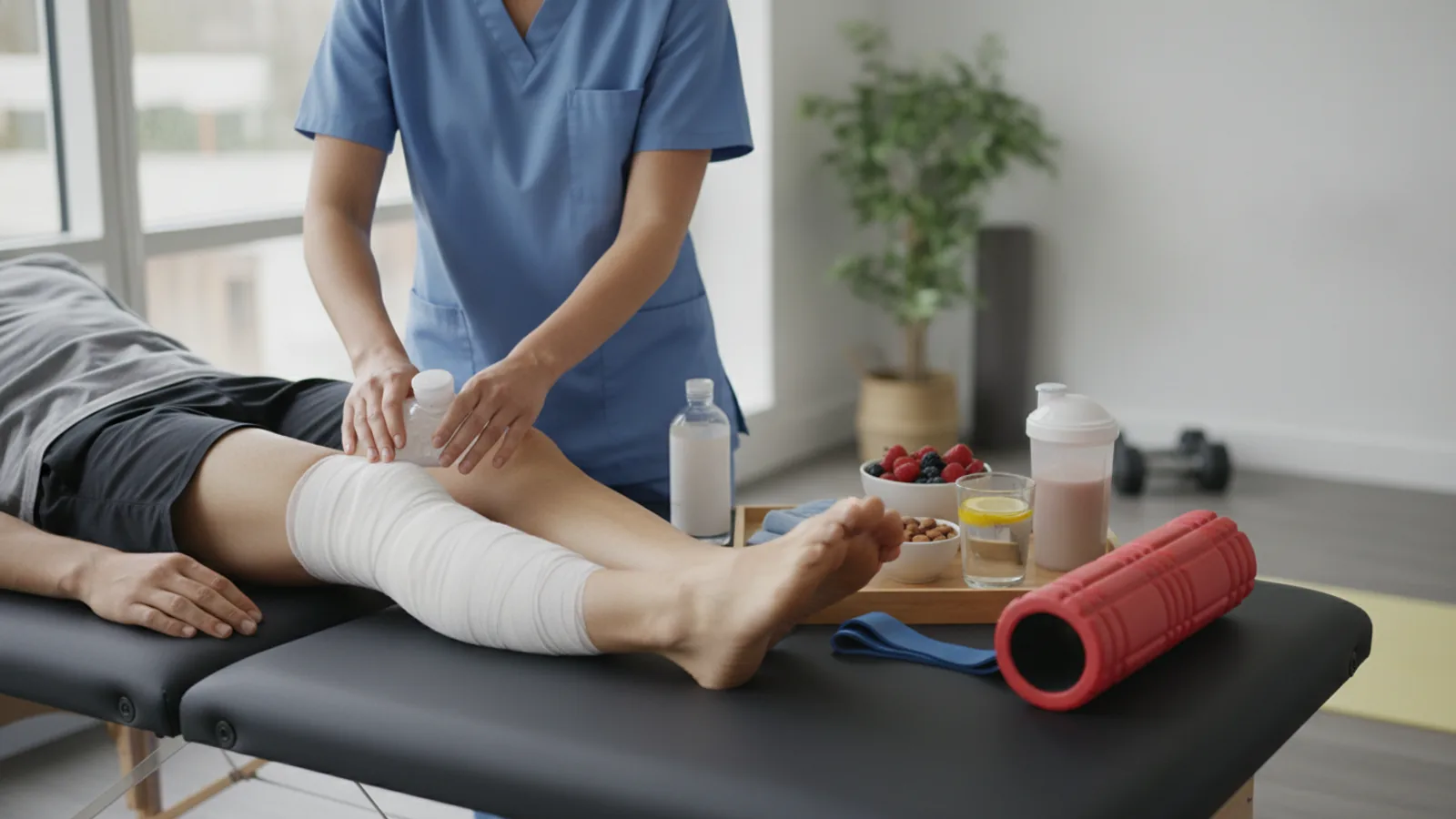
When applying the bandage, start wrapping at the point furthest from your heart and move towards it. For example, for a calf strain, start at the ankle and wrap upwards towards the knee. The wrap should be snug and supportive, but not tight. It should not cause throbbing, numbness, tingling, or an increase in pain. Be sure to remove the bandage when you go to sleep.
Step 5: Educate Yourself on Recovery (The 'E' in PEACE)
Understanding the healing process is a vital part of recovery. Your body is the primary healer; these steps simply create the best environment for it to work. Educate yourself on the importance of active recovery over passive treatments. A physiotherapist is an excellent resource for this. They can explain your specific injury, provide a realistic recovery timeline, and teach you how to manage your activity levels effectively.
This phase is about setting realistic expectations and understanding that "letting pain be your guide" is a core principle. Avoid the temptation to push through pain, as this can set your recovery back significantly.
Step 6: Introduce an Appropriate Load (The 'L' in LOVE)
After the initial 2-3 days of protection, you must begin to gradually re-introduce load to the muscle. This is where the 'LOVE' phase begins. Movement and mechanical stress are signals that tell the healing tissues how to align and strengthen. Without this, you risk forming weak, disorganised scar tissue, which is more prone to re-injury.
Start with gentle, pain-free range-of-motion exercises. For a strained hamstring, this could be gently bending and straightening your knee while sitting. An excellent next step is isometric exercise, where you tense the muscle without moving the joint. For instance, sit with your knee bent and gently press your heel into the floor to activate the hamstring for 5-10 seconds, then relax. This begins to reactivate the muscle without stressing the healing fibres.
Step 7: Cultivate Optimism (The 'O' in LOVE)
The psychological component of recovery is powerful. Feeling pessimistic, fearful of movement, or catastrophising the injury can negatively impact your outcome. The brain plays a significant role in pain perception and recovery. Stay confident and positive about your body's ability to heal.
Focus on the small improvements you make each day. Celebrate being able to walk a little further, bend a little more, or perform an exercise with less discomfort. A positive and realistic outlook can help motivate you to stick with your rehabilitation programme and has been shown to correlate with better functional outcomes.
Step 8: Promote Vascularisation (The 'V' in LOVE)
Vascularisation means promoting blood flow. A healthy blood supply delivers oxygen and the nutrients that are essential for tissue repair. The best way to achieve this is through pain-free cardiovascular exercise.
Choose an activity that doesn't stress the injured muscle. If you have a quadriceps strain, you might use a stationary bike with low resistance. If you have an arm injury, walking or jogging (if appropriate) can increase your heart rate and circulation. This not only aids the specific injury but also maintains your overall fitness, making the eventual return to full activity much smoother.
Step 9: Progress Your Exercises (The 'E' in LOVE)
This final step is about systematically rebuilding the capacity of the injured muscle. Under the guidance of a physiotherapist, you will progress through exercises that challenge your strength, flexibility, and proprioception (your sense of body position).
The progression typically follows this path:
- Isometric exercises (tensing without moving).
- Isotonic exercises (moving the muscle through its range, e.g., bodyweight squats).
- Strengthening with resistance (using bands or light weights).
- Functional and sport-specific movements (e.g., jumping, changing direction).
Each step should be completed without a significant increase in pain. This structured approach ensures the muscle tissue becomes strong, flexible, and resilient, significantly reducing the risk of another strain in the future.
Quick Reference
| Situation | Use this | Why |
|---|---|---|
| First 1-3 Days (Acute Phase) | P.E.A.C.E. Protocol | To minimise bleeding, manage swelling, and create an optimal environment for healing to begin. |
| After Day 3 (Sub-acute/Repair Phase) | L.O.V.E. Protocol | To promote high-quality tissue repair, restore function, and build resilience against re-injury. |
| You feel sharp pain during an exercise | Stop immediately and rest | Sharp pain is a signal of potential tissue damage. Pushing through it will delay recovery. |
| A dull ache develops after activity | Monitor it. Reduce intensity next time. | This often indicates you've slightly over-stressed the healing tissue. It's a sign to scale back, not stop completely. |
Common Problems When You Speed Up Muscle Strain Recovery
Returning to Activity Too Soon
The Problem: Impatience is the biggest barrier to a successful recovery. Feeling a bit better after a few days can lead to the temptation to jump back into sport or strenuous activity at full intensity. This is a primary cause of re-injury, which is often more severe than the original strain.
The Fix: Adhere strictly to a gradual, progressive rehabilitation plan, ideally designed by a physiotherapist. Recovery should be guided by functional milestones (e.g., ability to hop without pain), not by a date on the calendar.
Prolonged or Complete Rest
The Problem: The opposite of returning too soon is resting for too long. While initial protection is key, extended inactivity leads to muscle atrophy (wasting), joint stiffness, and a significant loss of strength, making the muscle even more vulnerable.
The Fix: Embrace the concept of 'relative rest' and active recovery. As soon as the initial, acute pain subsides, begin introducing gentle, pain-free movement and loading as described in the L.O.V.E. protocol.
Inconsistent Rehabilitation
The Problem: Performing strengthening and mobility exercises sporadically will not provide the consistent stimulus needed to rebuild strong, organised muscle tissue. Recovery requires consistent effort.
The Fix: Treat your rehabilitation exercises with the same importance as any other appointment. Schedule 10-15 minutes, two to three times a day if recommended, to perform your exercises. Consistency is far more important than intensity, especially in the early stages.
Advanced Tips for how to speed up muscle strain recovery
Focus on Nutrition and Hydration
Your body requires raw materials to rebuild tissue. Ensure you are consuming adequate protein, which provides the amino acid building blocks for muscle repair. A balanced diet rich in vitamins and minerals will support overall healing. Furthermore, staying well-hydrated is crucial for optimal cellular function and nutrient transport to the injury site.
Prioritise High-Quality Sleep
The majority of your body's tissue repair and the release of growth hormone occur during deep sleep. Consistently getting 7-9 hours of quality sleep per night is one of the most effective recovery strategies available. Establish a regular sleep schedule and create a restful environment to maximise this natural healing process.
Incorporate Eccentric Strengthening (Later Stage)
Once you are in the later stages of rehabilitation and cleared by your physiotherapist, incorporating eccentric exercises can be highly effective. This involves strengthening the muscle while it is lengthening under load (e.g., the slow, controlled lowering phase of a calf raise). This type of contraction is excellent for building resilient, robust muscle fibres that are resistant to future strains.
How To Speed Up Muscle Strain Recovery FAQ
Should I use heat or ice for a muscle strain?
Current P.E.A.C.E. & L.O.V.E. guidelines advise against the routine use of ice, as it may interfere with the essential inflammatory process needed for healing. Heat may be beneficial after the first 72 hours to increase blood flow and help relax tight muscles. Use a warm, moist towel or a covered heat pack for 15-20 minutes at a time.
How long does a pulled muscle take to heal?
Recovery time depends entirely on the severity (grade) of the strain. General estimates are: Grade 1 (mild): 2-4 weeks. Grade 2 (moderate tear): 4-8 weeks. Grade 3 (complete rupture): Can take several months and may require medical or surgical intervention. A physiotherapist can give you a more accurate prognosis after an assessment.
When should I see a doctor or physiotherapist?
You should see a doctor immediately for any signs of a severe injury (a 'popping' sound, inability to move the limb, severe pain or swelling). For a mild to moderate strain, it is highly advisable to see a physiotherapist. They can provide an accurate diagnosis, rule out other issues, and create a personalised rehabilitation programme to ensure a safe and complete recovery.
Is it okay to stretch a strained muscle?
Aggressive or painful static stretching should be avoided in the early, acute phase of recovery, as it can pull on the healing fibres and cause further damage. Gentle, pain-free mobility and range-of-motion exercises are more appropriate. Static stretching can be carefully introduced later in the rehabilitation process under the guidance of your therapist.
Final Checklist for how to speed up muscle strain recovery
- Have you ruled out a severe injury and sought medical attention if necessary?
- In the first 1-3 days, have you consistently applied the P.E.A.C.E. principles?
- After the acute phase, have you started the L.O.V.E. protocol by introducing gentle, pain-free load and movement?
- Is your exercise progression guided by your symptoms, ensuring you avoid sharp pain?
- Are you supporting your body's repair processes with good nutrition, adequate hydration, and prioritising sleep?
- Have you consulted a physiotherapist for a tailored diagnosis and rehabilitation plan to guide your return to full activity?