
Best Tricep Workouts 2026
Roundup review
Our 2026 analysis of upper-arm exercises involved reviewing over 25 common tricep movements, cross-referencing their biomechanical principles, muscle activation evidence from electromyography (EMG) studies, and scalability for different fitness levels. Based on its capacity for progressive overload and comprehensive muscle engagement, the Close-Grip Bench Press stands out as the best overall tricep workout for building foundational strength and mass.
Quick Comparison
Close-Grip Press
- Unmatched strength potential
- Targets all tricep heads
- Compound movement benefits
Tricep Pushdown
- Best for muscle isolation
- Constant tension on muscle
- Very safe with good form
Diamond Push-Up
- Best bodyweight option
- No equipment needed
- Builds functional strength
Overhead Extension
- Targets long head
- Excellent for muscle shape
- Versatile (cables/DBs)
Bench Dip
- Great for home workouts
- Minimal equipment needed
- Effective finishing move
The Best Tricep Workouts
- Close-Grip Bench Press - Best overall
- Cable Tricep Pushdown - Best for Isolation
- Diamond Push-Up - Best Bodyweight Option
- Overhead Tricep Extension - Best for Long Head Development
- Bench Dip - Best for Minimal Equipment
Close-Grip Bench Press
The Close-Grip Bench Press is a foundational compound exercise that places significant emphasis on the triceps brachii while also engaging the chest and shoulders. Its primary advantage lies in the potential for substantial progressive overload, allowing for continuous strength and hypertrophy gains. By narrowing the grip on the barbell, the mechanical load shifts from the pectoralis major to the triceps, making it a powerful movement for developing overall upper-arm mass. We rate it as the best overall tricep workout due to its proven effectiveness in building raw power and size, supported by decades of strength training application.
Pros
- Allows for heavy loads to maximise mechanical tension
- Effectively stimulates all three heads of the triceps
- Builds synergistic strength in the chest and shoulders
- Excellent for tracking linear progress over time
Cons
- Requires a barbell, rack, and bench
- Improper form can lead to wrist or shoulder strain
- May be intimidating for beginners without a spotter
Cable Tricep Pushdown
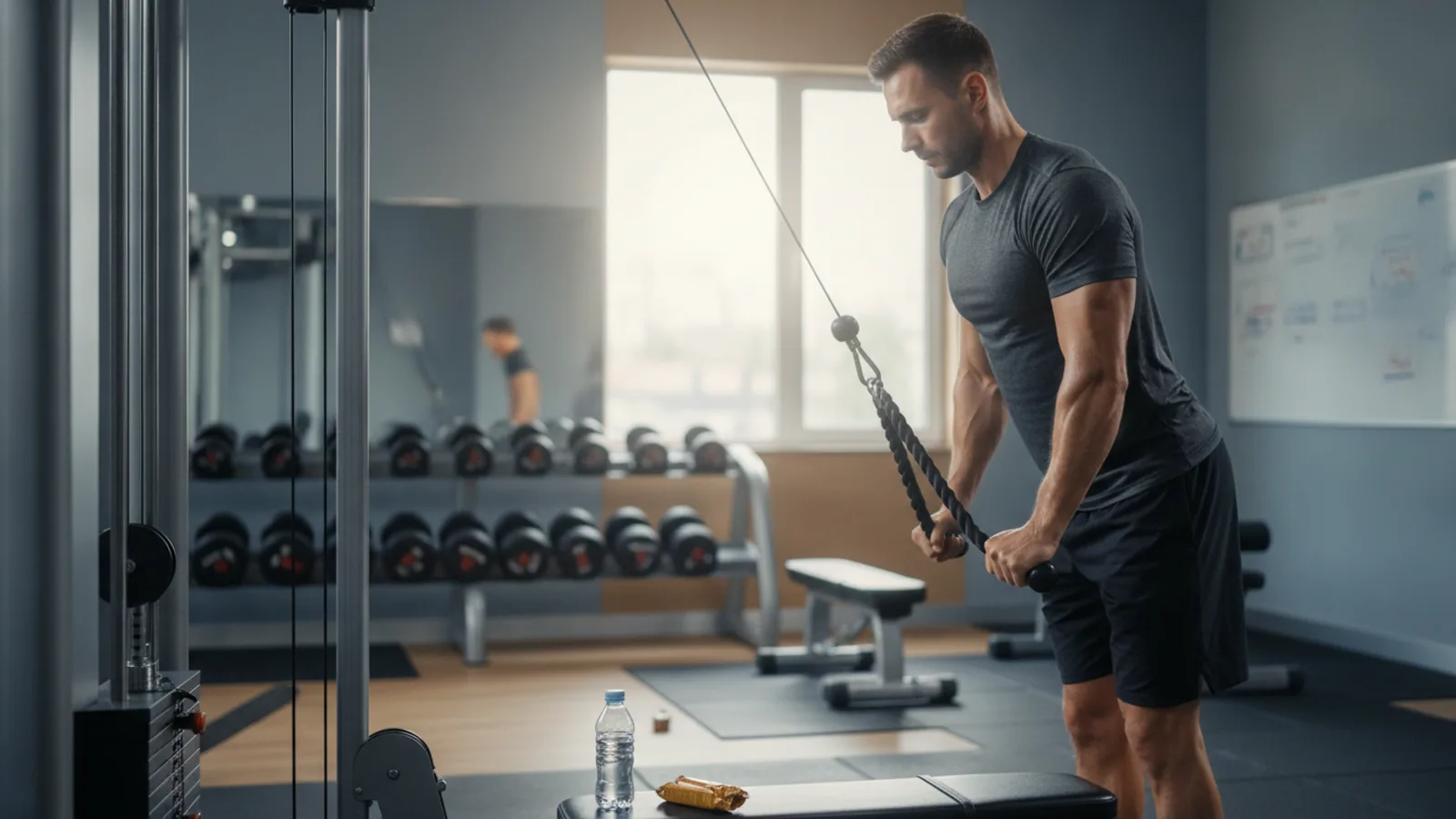
The Cable Tricep Pushdown is a premier isolation exercise designed to target the triceps, particularly the lateral and medial heads. Its primary clinical benefit is the constant tension provided by the cable machine throughout the entire range of motion, which is difficult to replicate with free weights. This consistent resistance can be highly effective for metabolic stress, a key driver of muscle hypertrophy. The movement is relatively easy to learn and execute with proper form, minimising the risk of injury and making it an excellent choice for individuals of all experience levels to safely target the tricep muscles without overloading adjacent joints.
Pros
- Provides constant, consistent tension on the muscle
- Low risk of injury when performed correctly
- Highly versatile with different bar attachments (rope, straight bar, V-bar)
- Excellent for high-repetition sets and warming up the elbows
Cons
- Requires access to a functional cable machine
- Lower potential for heavy loading compared to compound presses
- Primarily targets only two of the three tricep heads
Diamond Push-Up
The Diamond Push-Up is a highly effective bodyweight exercise that shifts the focus of a standard push-up from the chest to the triceps. By placing the hands close together to form a diamond shape, the angle of the press intensely recruits the triceps and anterior deltoids. As a closed-chain kinetic exercise, it promotes joint stability and functional strength. It is our top choice for a bodyweight tricep workout because it requires no equipment and can be performed anywhere, offering a challenging and scalable option for home workouts or when access to a gym is limited. However, caution is advised as the narrow hand position can place stress on the wrists and shoulders if mobility is limited or form is compromised.
Pros
- Requires absolutely no equipment
- Builds functional pressing strength and core stability
- Highly effective for tricep and chest development
- Can be modified (e.g., on knees) to adjust difficulty
Cons
- Can cause wrist or shoulder discomfort for some individuals
- Difficult to perform for beginners with lower upper-body strength
- Progressive overload is less straightforward than with weights
Overhead Tricep Extension
The Overhead Tricep Extension, whether performed with dumbbells, a cable, or an EZ-bar, is uniquely effective at targeting the long head of the triceps. The long head is the largest part of the muscle and is crucial for overall arm size, but it is only fully stretched and engaged when the arm is in an overhead position. This exercise places the tricep in this stretched position, which research suggests may be a potent stimulus for muscle growth (stretch-mediated hypertrophy). For individuals seeking to maximise the aesthetic appearance and size of their arms, incorporating an overhead movement like this is essential. It is versatile and can be adapted to the equipment available, making it a valuable addition to any comprehensive arm training programme.
Pros
- Specifically targets the long head of the tricep for maximum size
- Can be performed seated or standing with various equipment
- Promotes shoulder mobility and stability
- The stretched position can be a unique stimulus for growth
Cons
- Requires careful form to avoid flaring the elbows
- Can be uncomfortable for individuals with poor shoulder mobility
- Risk of dropping weight if grip fails during fatigue
Bench Dip
Bench Dips are a classic bodyweight movement that primarily targets the triceps using only a stable bench or chair. This accessibility makes them an excellent choice for home workouts or as a finishing exercise in a gym routine. The exercise involves lowering and raising the body by flexing and extending the elbows, placing a direct load on the triceps. While highly effective for muscle isolation, it is critical to perform this movement with caution. Overextending the range of motion or allowing the shoulders to roll forward can place significant stress on the anterior capsule of the shoulder joint. When performed correctly with a controlled range of motion, it is a valuable tool for tricep development with minimal equipment.
Pros
- Requires only a bench, chair, or stable elevated surface
- Effectively isolates the tricep muscles
- Can be made more difficult by elevating the feet or adding weight to the lap
- Simple and easy to learn the basic movement
Cons
- High risk of shoulder impingement if performed with poor form
- Not suitable for individuals with pre-existing shoulder conditions
- Limited load potential compared to other exercises
Buying Guide: How to Choose the Best Tricep Workouts
Selecting the appropriate tricep exercises is a clinical decision based on individual goals, physical limitations, and available resources. A well-rounded programme considers more than just which movement "feels" the hardest; it incorporates biomechanical principles to ensure comprehensive development and minimise injury risk. Before incorporating any new exercise, consult with a qualified fitness professional or physiotherapist, particularly if you have pre-existing joint issues.
Understanding Tricep Anatomy
The triceps brachii muscle, located on the back of the upper arm, is comprised of three distinct heads. For complete development, it is important to choose exercises that effectively target all three:
- Long Head: The largest part of the tricep, it crosses both the elbow and shoulder joints. It is best targeted when the arm is extended overhead (e.g., Overhead Extensions).
- Lateral Head: Located on the outer side of the humerus, this head is responsible for the "horseshoe" shape of the tricep. It is heavily engaged in most pressing movements (e.g., Pushdowns, Close-Grip Bench Press).
- Medial Head: Situated underneath the other two heads, the medial head is a workhorse active in nearly all tricep movements, especially at the point of full elbow extension.
A balanced routine should include at least one exercise that places the long head under a significant stretch (overhead movements) and one or more pressing movements for the lateral and medial heads.
Aligning Exercises with Your Goals
Your primary fitness objective should dictate your exercise selection and training parameters.
- For Strength: Focus on compound movements that allow for heavy loads and low repetitions (e.g., 4-6 reps). The Close-Grip Bench Press is ideal for this goal. Progressive overload—gradually increasing the weight lifted—is the key principle.
- For Hypertrophy (Muscle Size): A combination of compound and isolation exercises is most effective. Use moderate loads for a higher repetition range (e.g., 8-12 reps). Exercises like Cable Pushdowns and Overhead Extensions create metabolic stress and constant tension that can drive muscle growth.
- For Muscular Endurance: Lighter weights or bodyweight exercises for high repetitions (e.g., 15+ reps) are suitable. Bench Dips and Diamond Push-Ups (modified if necessary) are excellent choices.
Equipment Availability and Accessibility
The best workout is one you can perform consistently and safely. Your choice will be constrained by your environment.
- Full Commercial Gym: You have access to barbells, dumbbells, and cable machines. This allows for a comprehensive routine using movements like the Close-Grip Bench Press and Cable Pushdowns.
- Home Gym / Minimal Equipment: If you have dumbbells or resistance bands, you can perform Overhead Extensions, Tricep Kickbacks, and Dumbbell Skull Crushers. A simple bench allows for Bench Dips.
- No Equipment: Your options are limited to bodyweight exercises. Diamond Push-Ups and Bench Dips (using a chair) are the most effective choices.
The Primacy of Proper Form and Safety
Incorrect form is the leading cause of training-related injuries. When selecting and performing any tricep workout, prioritise the following:
- Elbow Health: Avoid "locking out" or hyperextending the elbow joint at the end of a repetition. Maintain a slight bend to keep tension on the muscle, not the joint.
- Shoulder Position: For pressing movements and dips, keep your shoulders depressed (down) and retracted (back). Allowing the shoulders to roll forward can lead to impingement.
- Wrist Alignment: Maintain a neutral wrist position. Bending the wrists excessively during presses or push-ups can lead to strain.
- Controlled Tempo: Perform each repetition in a controlled manner, especially during the eccentric (lowering) phase. This increases time under tension and reduces the risk of injury from momentum.
Final Verdict: Best Tricep Workouts
After a thorough analysis of biomechanics, safety, and application, our conclusion is that a varied approach is superior for long-term tricep health and development. However, if one exercise must be chosen for its overall impact on strength and size, the Close-Grip Bench Press is the top selection for 2026. Its capacity for heavy, progressive loading makes it an unparalleled tool for building a strong foundation.
For a complete and well-rounded routine, we recommend combining the Close-Grip Bench Press with an isolation movement like the Cable Tricep Pushdown and an overhead movement such as the Overhead Dumbbell Extension. This ensures all three heads of the tricep are stimulated under different mechanical conditions, leading to more comprehensive and aesthetically balanced results.
Best Tricep Workouts 2026 FAQ
How many tricep exercises should I do per workout?
For most individuals, selecting 2 to 3 different tricep exercises per workout is sufficient. This allows you to target the muscle from different angles (e.g., a compound press, an overhead extension, and a pushdown) without causing excessive fatigue or overuse injury. Total volume should typically fall within 9-15 total work sets per week for the triceps.
Can I build large triceps with only bodyweight exercises?
Yes, it is possible to build significant tricep size and strength with bodyweight exercises, but it is more challenging. Exercises like Diamond Push-Ups and Dips are highly effective. The primary difficulty lies in applying progressive overload. To continue making progress, you will need to manipulate variables such as leverage (e.g., elevating feet), adding pauses, or increasing repetition volume, as you cannot simply add more weight.
How often should I train my triceps?
The triceps are a relatively small muscle group that recovers fairly quickly. For most people, training triceps directly 1 to 2 times per week is optimal. Remember that they also receive significant secondary stimulation during chest and shoulder pressing movements, so this should be factored into your total weekly training volume to avoid overtraining.
Are dips bad for your shoulders?
Dips are not inherently bad for the shoulders, but they carry a higher risk of injury if performed with improper form or by individuals with poor shoulder mobility or pre-existing conditions. The primary risk is anterior shoulder impingement. To perform them more safely, keep your chest up, avoid letting your shoulders roll forward, and do not descend past the point where your upper arms are parallel to the floor. If you experience pain, stop immediately and choose an alternative exercise.
What is the difference between a tricep pushdown and a tricep kickback?
A tricep pushdown involves extending the elbow from a position where the upper arm is stable by your side, primarily targeting the lateral and medial heads. A tricep kickback involves extending the elbow from a position where the upper arm is parallel to the floor. This position changes the resistance curve and can place more emphasis on the tricep at peak contraction. However, kickbacks severely limit the amount of weight you can use, making them generally less effective for building mass than pushdowns or extensions.